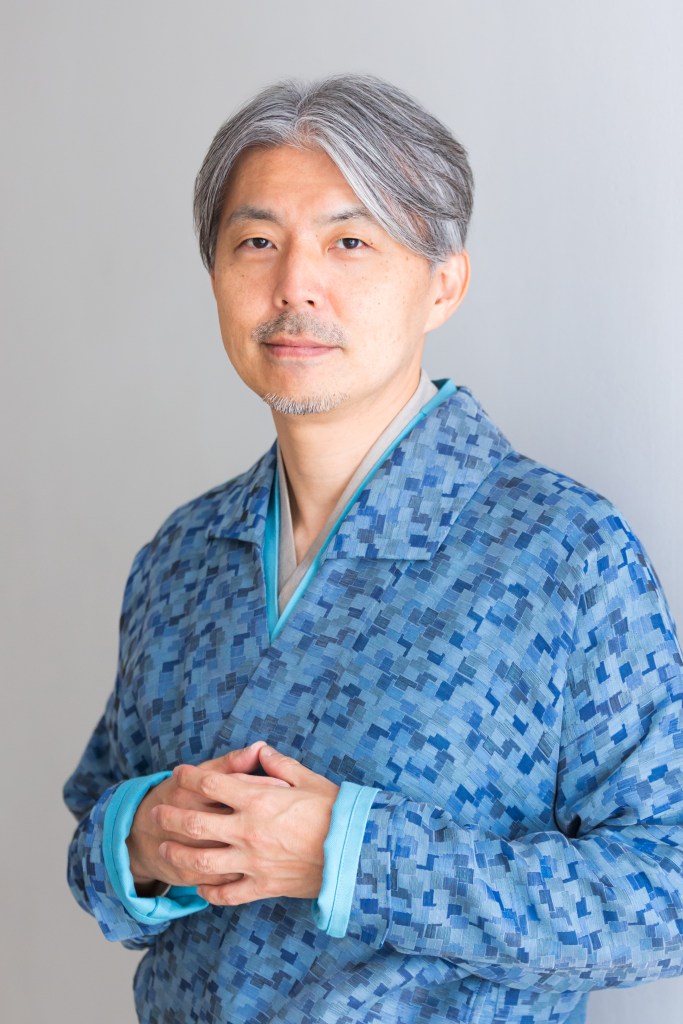
Reijiro Tsumura — Representative Director Representative Director: Reijiro Tsumura (Kanze School, Ryokusenkai) Head of the Ryokusenkai (Kanze school); Kanze-school shite-kata (lead Noh actor) and holder of the Important Intangible Cultural Property designation for Nōgaku. Summary of major activities & representative works Reijiro Tsumura is a leading Kanze-school shite performer and the head of the Ryokusenkai. He is a designated Holder of Important Intangible Cultural Property (Nōgaku) and an active member of both the Nōgaku Association and the Japan Noh Association. In addition to serving as a specially appointed professor in the Faculty of Letters at Nishogakusha University, he has lectured at Hitotsubashi University. While a student at Hitotsubashi University he studied under Tsumura Kisako—one of the pioneering female Noh performers—and later received further instruction from the previous head, Kanze Yoshiyuki. In 1974 he succeeded as leader of the Ryokusenkai. He is also an author of works intended to broaden public understanding of Noh, including Nō & Kyōgen: An Illustrated Guide and 100 Keywords to Understand Noh. In 2015 the documentary film Dancing Traveler: Portrait of Noh Performer Reijiro Tsumura (dir. Nagaru Miyake) was released, documenting his life and practice. Tsumura’s artistic range extends beyond classical Noh: he actively creates and performs in newly composed Noh works and contemporary pieces, frequently collaborating with prominent artists across disciplines. In 1979 he co-founded the Koganei Takiginō (Koganei Takiginō Festival) with writer Hayashi Nozomu; the event celebrated its 47th edition in 2025 and has played a significant role in fostering local culture and Noh’s development. His boundary-crossing collaborations include work with dancer Kaiji Moriyama, choreographer Hana Sakai, prosthetic-leg dancer Kōichi Ōmae, and opera singer Takashi Fukui, among others. Internationally, he served as a Cultural Exchange Envoy for the Agency for Cultural Affairs in 2010, visiting Russia and Hungary to promote Noh abroad. Since 2019 he has worked with composer Makito Shibuya on new creations such as Ame ni mo Makezu, the NOSARU European tour, and the original work Shuri, staged at venues including the Okinawa National Theatre and the Cerulean Tower Noh Theatre. In 2024 he collaborated on creative Noh productions at the National Noh Theatre, including the commissioned work Naruto’s Ninth Symphony.
Makito Shibuya ー Composer / Executive Director Born in Sendai City, Miyagi Prefecture, Japan, in 1976, Makito Shibuya graduated from Miyagi University of Education. He began his career as a composer and cellist before relocating to Tokyo, where he is also active as a music teacher at a private school. Shibuya’s compositional output is rooted in the Western classical tradition and includes piano works, chamber music, choral pieces, and orchestral scores. His music is characterized by an approachable, distinctly Japanese sensibility and a refined aesthetic; three albums of his original works have been released to date. In recent years he has focused increasingly on projects that honor Japanese culture and identity, creating works that integrate traditional instruments such as shakuhachi, biwa, koto, shō, and taiko, and collaborating with practitioners of Noh and Ryukyuan music. He regularly composes and arranges pieces for both amateur ensembles and professional musicians and maintains ongoing collaborative relationships with Taiwanese conservatory-trained performers. Notable projects include the stage adaptation of Kenji Miyazawa’s Ame ni mo Makezu (“Be Not Defeated by the Rain”), created with Kanze-school Noh artist Reijirō Tsumura, choreographer Kaiji Moriyama, and dancer Kōichi Ōmae (a prosthetic-leg dancer). Featuring a mix of traditional instruments, cello, and the tenor Kei Fukui, the work has been staged repeatedly—among other venues—at the Cerulean Tower Noh Theatre to strong acclaim. His work Shuri, which fuses Ryukyuan music with Noh and honors the reconstruction of Shurijō Castle, was presented at the Koganei Takigi Noh (2021) and the National Theatre Okinawa (2023). His internationally presented TAMAKI -TORUS-—a daring synthesis of Japanese instruments, Noh, and vocal music—has been showcased at festivals such as the Besançon Early Music Festival and the Copenhagen World Music Festival, and was performed to a full house in the Sagrada Família crypt in Barcelona, receiving praise from members of the Gaudí family and the Japanese Consulate. In 2025 he composed and served as music director for 鬼問 (Ki-Mon), his second collaboration with Kaiji Moriyama. The piece premiered at the 47th Koganei Takigi Noh and was met with great acclaim. Shibuya’s work also extends to film: he composed the score for Ryu Miyake’s documentary Dressing the Passing of Time (Utsuroi no Toki o Matou), a film about the Japanese fashion label matohu that was selected for the 41st Montreal World Film Festival. In 2024 he contributed music for a dance-theater adaptation of the new Noh play Golden Sakura (written by Rimbō Hayashi), directed and choreographed by Naoya Homan, which featured Reijirō Tsumura and Akira Akiyama and received critical praise. He continues to write and arrange for Taiwanese artists and to present works across Europe, Southeast Asia, the Middle East, and beyond. As Executive Director of WAON, Shibuya promotes public engagement with Japanese music and traditional performing arts and fosters international cultural exchange. He also serves as an advisor to the Japan–Taiwan Cultural and Arts Exchange Association. Note: the character 渋 in his surname is a Japanese form; in some Chinese-language contexts it is rendered as 渉谷.

 一般社団法人 和音